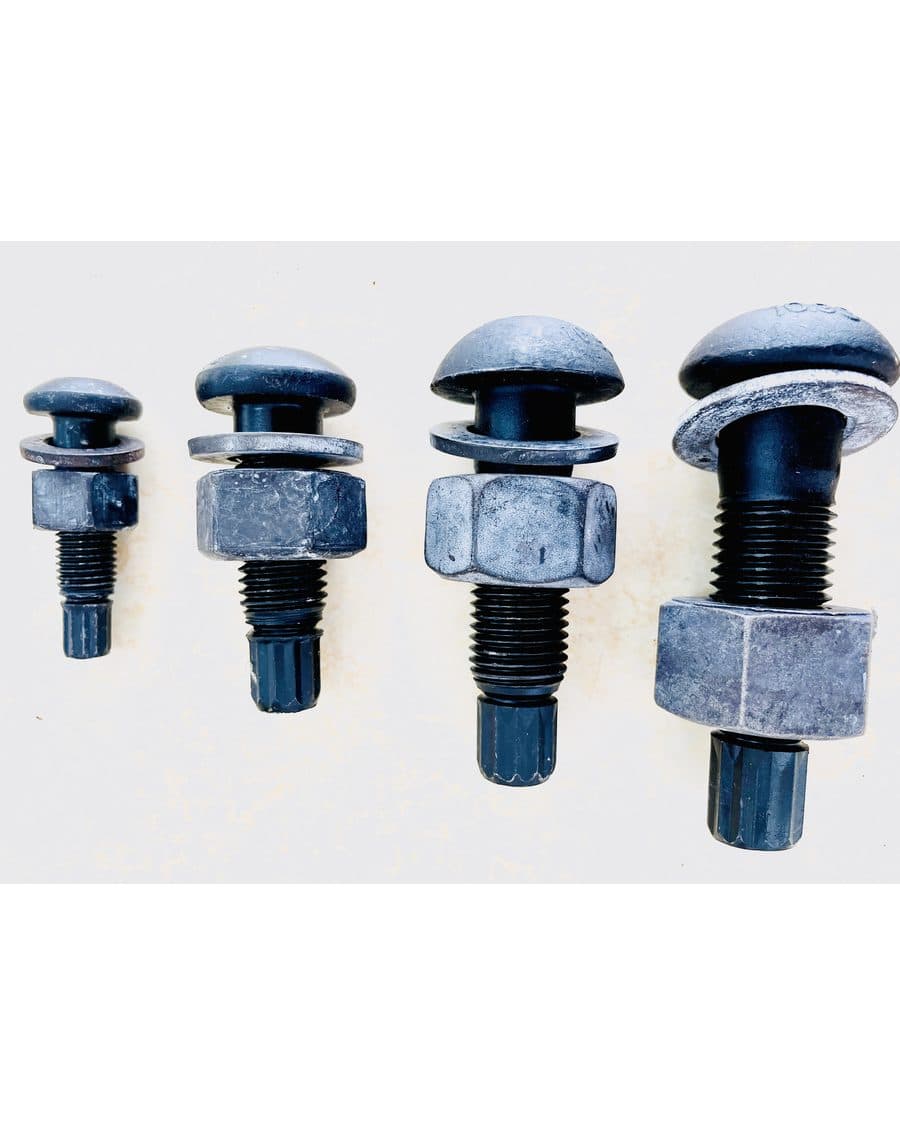
TC bolts and high-strength hex bolt sets can both be used in structural steelwork, but they are not interchangeable installation systems. A TC set is tightened until a tension-control feature releases; a high-strength hex set is tightened by a method specified for the connection and verified with the required equipment and records.
The correct choice starts with the connection design and the project specification, not with the tool already on site.
What is a TC bolt set?
TC commonly refers to a tension-control or torque-shear bolt assembly. The exact name and geometry vary by standard and supplier, but the system normally has a splined or specially formed end and a nut designed to control the tightening operation.
The installer uses the specified wrench until the control feature breaks or releases. That event indicates that the installation step has been completed to the system's own setting mechanism. It does not remove the need to follow the project's approved procedure, inspect the installation and keep the required records.
For a project using GB/T 3632, the relevant product is a torsional shear type high-strength bolt set. The standard, grade and connection design must still be read together; calling a part a “TC bolt” is not enough to establish compliance.
What is a high-strength hex bolt set?
A high-strength hex bolt set normally consists of a large hex-head bolt, a matching nut and hardened washers. It is a different assembly from a TC set and is installed with a tightening method chosen for the connection type.
That method may involve a calibrated torque wrench, turn-of-nut control, a direct-tension indicator or another procedure accepted by the project specification. The correct method is not determined by the bolt diameter alone. It depends on the standard, grade, coating, lubrication condition, connection type and inspection requirements.
The practical differences
| Question | TC bolt set | High-strength hex bolt set |
|---|---|---|
| Main identifying feature | Tension-control end or nut | Large hex head with matching nut and washer |
| Installation signal | The control feature releases at the specified operation | The approved tightening procedure is completed and checked |
| Tooling | System-specific installation wrench or equipment | Equipment selected for the approved tightening method |
| Inspection | Confirm correct assembly, seating and release; follow project records | Confirm the specified tightening method and record the required checks |
| Main procurement risk | Mixing parts from different systems | Mixing bolt, nut and washer from unmatched batches or grades |
| Drawing information | Standard, grade, size, grip, coating, nut/washer and installation requirements | The same information, plus the required tightening method |
Treat TC and SC shorthand carefully
Searches and site conversations often use short labels such as “TC” and “SC”. Those abbreviations are not a universal substitute for a product standard. Different regions, suppliers and project documents may use them differently.
Before quoting or installing, write out:
- the product standard;
- the bolt grade;
- the complete assembly, including nut and washer;
- the required coating;
- the installation and inspection method;
- the document package required for the batch.
If a drawing only says “TC bolt” or “SC bolt”, issue a technical query. A short abbreviation can hide a different product system, a different tightening method or a different acceptance record.
What decides the choice?
The decision belongs to the connection designer and the project specification. The main inputs are:
- The connection type. Bearing and slip-critical connections do not necessarily use the same tightening criterion.
- The governing standard. A product should be supplied against the named standard and grade, not against a generic description.
- The installation method available on site. The contractor must have the correct tooling and competent personnel for the specified system.
- Inspection requirements. The project may require witness points, torque records, calibration records or other evidence.
- Coating and friction condition. A coating can change the tightening behaviour and must be consistent across the batch.
- The approved product and sample. A substitute should not be introduced solely because it is easier to obtain.
Tightening is not a number copied from a table
Do not accept a torque value from a website, a catalogue page or a previous project and apply it to a different bolt. The required tightening value or method is a project decision based on the standard, the assembly, the coating, the connection and the inspection method.
This is also why a supplier should not publish an arbitrary torque figure for every product. A responsible quotation will state what the supplier can provide for the specified batch and what must be confirmed by the project's engineer or installer.
What to put on the drawing and RFQ
For either system, the enquiry should state:
- the product standard and grade;
- thread diameter, pitch and length, or grip length with plate thicknesses;
- the full assembly: bolt, nut and washers;
- the coating system, including any coating standard;
- the connection type and required tightening or installation method;
- the inspection and document requirements;
- quantity by connection mark or bolt group;
- packing and marking instructions for site issue;
- the approved sample or product reference, if one exists.
For a TC set, identify the complete system and the installation equipment requirement. For a hex set, identify the nut and washer grade and the approved tightening method. In both cases, the parts must be treated as a matched assembly.
Common mistakes
- Using “TC” as if it were a complete specification. It is a shorthand, not a substitute for the standard and grade.
- Mixing a TC bolt with a nut from another system. The assembly may not function as designed.
- Using the wrong wrench or installation procedure. The release of a control feature must follow the approved method, not a guessed setting.
- Assuming any high-strength hex bolt can replace a TC bolt. The connection design and installation method must be checked first.
- Ignoring coating effects on tightening. The finish must be part of the approved assembly, not an afterthought.
- Skipping the inspection record. The project may require evidence that the specified method was actually used.
Tangtie supplies torsional shear bolt sets and high-strength structural bolt sets to drawing or the stated standard. The quotation can list the achievable dimensions, assembly, finish and document package. It does not replace the connection design or the project's installation approval.
Next step: send the connection drawing and the specified bolt standard. The RFQ should identify the complete assembly and the required installation method before pricing is compared.
This note is general technical guidance prepared for the product library. It is not a project-specific approval and does not replace the specification issued by the project engineer. Values requiring test evidence are not published.