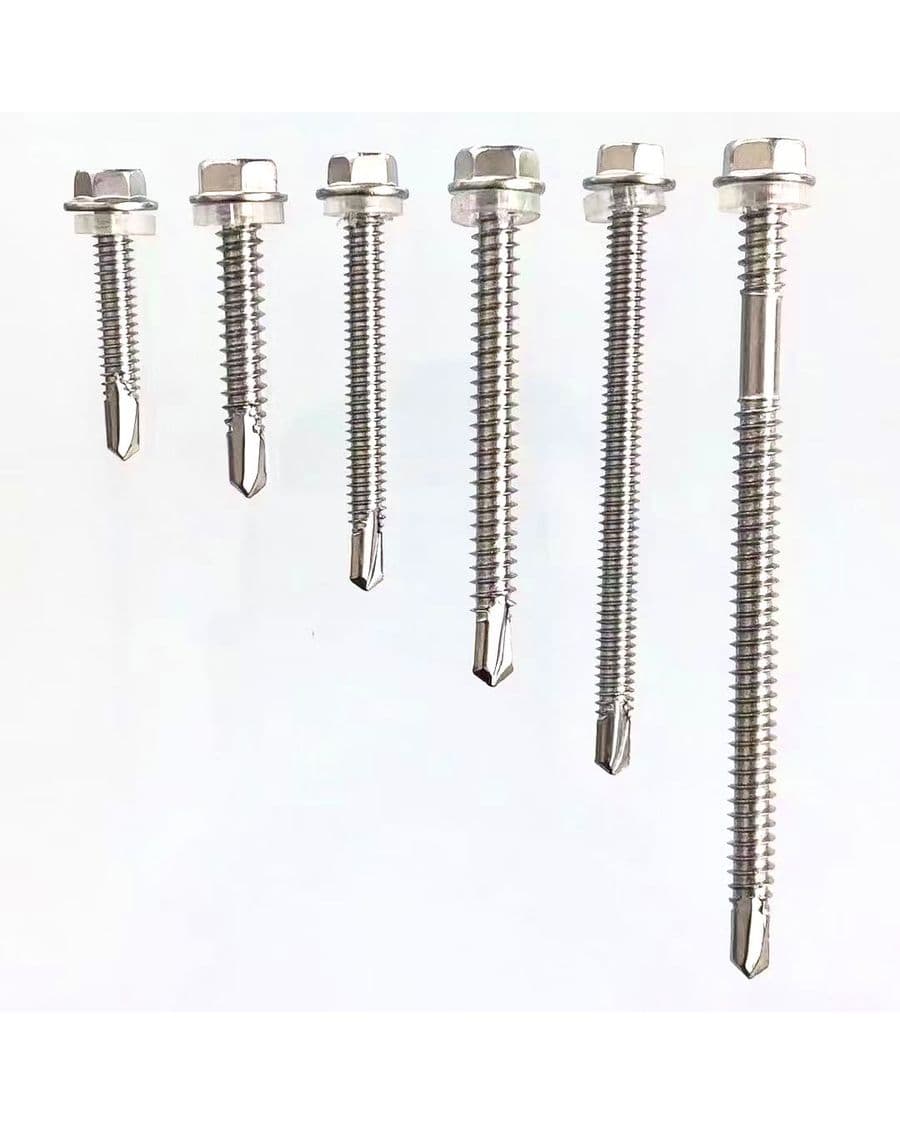
A self-drilling screw for metal cladding has to do three jobs at once: drill the steel, form or engage a thread and seal the penetration. A screw that is the right diameter but the wrong length or drill point can leave a leak path, strip the thread or fail to engage the purlin.
The correct specification starts with the material stack, not with a photograph of a screw head.
What is a self-drilling screw?
A self-drilling screw has a drill point that cuts its own hole, followed by a thread that engages the supporting steel. A cladding screw usually has a bonded or separate washer with an EPDM or similar sealing ring. It is used for metal roof and wall sheets, liner panels, flashings and some facade components.
It is different from a self-tapping screw, which normally needs a pre-drilled hole, and from a blind rivet, which does not use a threaded connection.
How is the length determined?
The screw must pass through the cladding and any spacer, then engage the purlin or frame by the required amount. The length stack-up usually includes:
- cladding sheet thickness;
- insulation or spacer thickness, if used;
- washer compression;
- the threaded engagement in the supporting steel;
- the drill point length beyond the engaged thread.
If the screw is too short, it may not engage enough thread. If it is too long, the point may protrude through the frame or damage a cable, membrane or finished surface on the other side. The drawing or schedule should define the stack-up, not only the screw length.
Does the drill point match the steel thickness?
The drill point has to suit the supporting steel. A point designed for thin sheet may not drill a heavier purlin efficiently; a point for heavy steel may enlarge the hole in thin sheet or damage the cladding. The screw manufacturer's data should be used to match the point to the steel thickness.
The same principle applies to the thread. The thread pitch and diameter must engage the supporting member without stripping it. A screw that works in a thin liner may not be suitable for a structural purlin.
What does the washer do?
The washer is part of the sealing system. It spreads the clamping force and compresses the sealing ring against the cladding. Over-tightening can deform the washer or the sheet; under-tightening can leave the seal loose.
The installation tool should have a depth-sensitive nose or clutch where required. The operator should confirm the correct seating condition from the approved procedure, not by tightening until the sheet deforms.
What should an RFQ include?
Send:
- Cladding material, thickness and profile.
- Purlin or frame material and thickness.
- Whether insulation, spacer or liner is present.
- Required screw length and thread engagement.
- Head type and drive.
- Washer type and sealing material.
- Drill point type or the steel thickness it must drill.
- Coating and colour requirement.
- Installation tool and torque-control method.
- Quantity by length and packing requirement.
Common mistakes
- Choosing by screw length alone. The material stack and thread engagement matter.
- Using one screw for every substrate. Thin sheet, heavy purlin and timber need different details.
- Ignoring the washer. A damaged or missing sealing ring creates a leak path.
- Over-driving the screw. The washer and sheet can be deformed.
- Mixing coated and uncoated fasteners. The exposed fastener should match the cladding finish and exposure.
- Leaving the drill point specification to the installer. The point must match the supporting steel.
Tangtie's cladding fastener scope
Tangtie supplies self-drilling screws and envelope accessories for metal cladding and facade packages. We can supply to the approved size list; the cladding system designer remains responsible for the fixing layout and pull-out verification.
Next step: send the cladding build-up, purlin thickness and required screw layout. The quotation can then distinguish length, drill point, washer and finish instead of quoting a single generic screw.
This note is general technical guidance prepared for the product library. It is not a project-specific approval and does not replace the specification issued by the project engineer. Values requiring test evidence are not published.